View Post

What we do during an oil change

In Brakes, Oil Change, Tires & Wheels, Vehicle Fluids, Vehicle Maintenance by HomeTowne Auto Repair & Tire

Oil changes are a form of maintenance that most drivers are familiar with.

This service is necessary for your vehicle to run properly. Oil is needed to lubricate many components and some parts feature oil pressure sensors. 

Regular oil changes, which are suggested every 3,000 to 5,000 miles, prevent engine damage from occurring down the road. You can read more about why they are important in this blog post we wrote.

During this service, the oil and oil filter are replaced. HomeTowne Auto Repair & Tire takes it a few steps further by providing additional services.

What an oil change looks like at HomeTowne Auto Repair

While completing an oil change, we always use seat covers, floor mats, and steering wheel covers to protect the vehicle.

In addition to replacing the oil and oil filter, our technicians perform a courtesy inspection. This includes several safety checks, such as testing the battery. They also examine the air filters and look over the belts and pulleys. 

The fluids are checked, as well. We look at the windshield washer fluid, brake fluid, coolant, power steering fluid, and transmission fluid.

Not all of the fluids have a warning light when they’re low and you may not know until something happens. Being low on oil or coolant might cause an alert. That isn’t the case with power steering fluid and transmission fluid.

Measuring the brake pad depth is another part of the process. To pass the Virginia state inspection, they must be at least 2/32 of an inch. We start suggesting replacing the brakes when they reach 3/32 or 4/32 of an inch, but some manufacturers recommend them sooner.

The tires are also measured and rotated, which helps them last longer.

To confirm there isn’t any play or damage, the steering and suspension are inspected. Parts can become loose or go bad overtime. If they aren’t replaced early on, they could lead to more expensive repairs in the future.

Additionally, our technicians make sure the lights are working properly.

The courtesy check and tire rotations are services provided at no additional charge.

We believe in maintaining your car before it breaks down. If we can catch problems early, then we can potentially save people money.

Digital inspections

Any observations our technicians make while performing an oil change or courtesy inspection are noted in digital inspections.

Through digital inspections, we are able to share photos, videos and information about the health of your vehicle. This includes details about what’s looking good, repairs that need to be made, and services we recommend.

These reports can be sent via text or email, allowing you to receive an update wherever you are.

Is your vehicle due for an oil change? You can schedule one at HomeTowne Auto Repair by calling (703) 594-4646.

HomeTowne Auto Repair & Tire is an authorized Michelin and BFGoodrich tire dealer located in Woodbridge, Virginia. Automotive repair services are performed on all makes and models, including oil changes, brakes, alignments, inspections, and computer engine diagnostics.

View Post

Why you should buy Michelin tires, BFGoodrich tires now

In Tires & Wheels by HomeTowne Auto Repair & Tire

Whether you’re driving a performance car or an offroading vehicle, Michelin has plenty of options available.

It produces a variety of tires that meet the needs of today’s vehicles.

If you’re thinking about investing in some new Michelin tires, BFGoodrich tires, or Uniroyal tires, you may want to consider buying them sooner rather than later.

On September 1, 2021, Michelin North America, Inc. is raising its prices for certain Michelin, BFGoodrich and Uniroyal tires, according to an email from the company. They will increase up to 8 percent for passenger and light truck tires, up to 4 percent on motorcycle tires, and up to 14 percent for on and off road commercial tires.

HomeTowne Auto Repair sells a wide range of tires, including those produced by Michelin North America. 

Below are some great all season tires you should consider. (You can receive $40 off when you buy a set of four of the tires listed below, a wheel alignment, and road hazard – simply mention this article.)

Tires

Michelin Tires

Michelin Defender Tire: This tire has grown in popularity over the years. Available for all types of vehicles – including SUVs, trucks and passenger cars – it comes with a mileage warranty of up to 80,000 or 90,000 miles.  

Michelin Premier A/S Tire: Do you drive a passenger car or minivan? The Michelin Premier A/S Tire, which is backed by a 60,000 mile warranty, is one that offers safety and a comfortable ride. 

Michelin Pilot Sport A/S 3 + Tire: If you’re looking for a tire that works well in snowy, wet and dry weather, the Michelin Pilot Sport A/S 3 + Tire is a good choice. It comes with a 45,000 mile warranty.

BFGoodrich Tires

BFGoodrich Advantage T/A Sport Tire: This high quality tire is similar to the Michelin Defender Tire. The BFGoodrich Advantage T/A Sport Tire lasts up to 70,000 miles and offers better traction during rainy and light snowy conditions.

BFGoodrich Advantage Control Tire: The BFGoodrich Advantage Control Tire has biting edges that offer wet weather traction as well as grooves, which push away water. This tire also features a 75,000 mile treadlife warranty.

BFGoodrich All-Terrain T/A KO2 Tire: Those with light trucks, SUVs and CUVs may like the BFGoodrich All-Terrain T/A KO2 Tire, which is designed with more rubber thickness and 3-D sipes. Rated for severe snow, it provides a 50,000 mile warranty.

Uniroyal Tires

Uniroyal Tiger Paw Touring A/S Tire: If you are in need of a long lasting tire that’s safe, consider the Uniroyal Tiger Paw Touring A/S tire. It can be used on most CUVs, small and medium SUVs, and passenger vehicles and is backed by a 75,000 mile warranty.

Uniroyal Tiger Paw GTZ All Season 2 Tire: Commuters can receive a quiet ride with the Uniroyal Tiger Paw GTZ All Season 2 tire. Wide grooves, snow bars, and a 50,000 mile warranty are among its features.

Uniroyal Laredo Cross Country Tour Tire: Light truck, SUV and CUV owners – check out the Uniroyal Laredo Cross Country Tour tire. Thanks to wide, circumferential grooves, this all season option is able to evacuate water. Offering a 60,000 mile warranty, the Uniroyal Laredo Cross Country Tour tire is great in wet and dry weather, and a bit of snow.

HomeTowne Auto Repair & Tire is an authorized Michelin and BFGoodrich tire dealer located in Woodbridge, Virginia. Automotive repair services are performed on all makes and models, including oil changes, brakes, alignments, inspections, and computer engine diagnostics.

View Post

The role car computers play

In Automotive Diagnostics by HomeTowne Auto Repair & Tire

When you turn on your car, you’ll notice lots of lights on the dash and it may take a few moments before it stops looking like a Christmas tree.

The reason? There are many computers and modules that run various systems, such as the transmission and engine. Giving the car a minute allows these computers – called Electronic Control Units (ECUs) – to reset. Together, the ECUs form the Controller Area Network (CAN).

Sensors and modules send information to the computers and there are gateway modules that help direct traffic. So not only do you have sensors, you’ve got modules that actually control things, gateway modules that allow access, the CAN network, and the computer.  

Signs of computer problems and how we address them

If there’s a problem with a computer, the vehicle won’t work the way it should. You may notice a few issues. In addition to triggering the check engine light, a malfunctioning computer can impact the fuel economy and result in a no start.

Depending on what it is, there are driver information centers. It can be done through the dashboard lights or small computer screens that explain what’s going on or the system being affected.

Electronic problems can be difficult and time consuming to fix. Our technicians begin addressing the problem by performing a visual inspection. Then, we hook up the computer. We have special scan tools and we even have different ones depending on the type of car we’re working on. The scan tools at the auto parts stores may give you a code, but they don’t allow you to have full access. 

Reasons car computers fail

There are many possible culprits that can lead car computers to fail. It can be as simple as a sensor going bad and needing to be replaced.

Wiring can also become chafed. We’ve seen everything from too much being crammed under the seats, where a lot of modules are now located. In low end and high end vehicles, we have seen problems that have been the result of people spilling drinks or leaving the windows open. 

Sometimes, water leaks can occur due to windshield seals. The water goes in and it will corrode the connectors. You may not see it, so it could be difficult to diagnose because the water goes in, gets in the connector and starts to corrode it, causing an intermittent problem.

Water that collected in the well of a Mercedes, causing a module to corrode.
Water collected in the well of a Mercedes, causing a module to corrode.

In the case of one Mercedes, water soaked into the carpet and collected in the well, which was below the floor mat level. Overtime, this issue caused the module to corrode.

We’re finding water intrusion problems with all of the electronics in these cars – not just with the Mercedes. Even with the way the metals are sometimes made, you’re getting corrosion or connection problems, and that’s what’s leading components to fail. 

Some modules are underneath the vehicle or behind bumpers on panels. Even though they aren’t out in the elements, they see a lot of water and salt from the road. We’ve seen modules corrode on the outside and ruin the modules.

Shortage of car parts

With the parts shortages right now, where we used to be able to get just about any part within 2 to 4 days – even if it wasn’t as common – we’re starting to receive them in 2 to 4 weeks. 

For some of these older vehicles, we’re needing to rely on remanufacturers. You’re not able to get some new old stock from the dealer anymore. There’s even a shortage of used parts for some remanufacturers to rebuild them. So we may have to remove the part, send it off for repairs, and wait for them to send it back. That can take 3 to 6 weeks. 

With all that’s going on with the economy, it can delay vehicles getting fixed because we don’t have any other choice.

HomeTowne Auto Repair & Tire is an authorized Michelin and BFGoodrich tire dealer located in Woodbridge, Virginia. Automotive repair services are performed on all makes and models, including oil changes, brakes, alignments, inspections, and computer engine diagnostics.

View Post

All about axles: Different types and signs that they’re going bad

In Vehicle Maintenance by HomeTowne Auto Repair & Tire

In our daily rush with work, errands and family activities, we heavily rely on our vehicles.

Axles play the important role of making sure that the wheels keep turning. These parts connect the wheels and bear a car’s weight.

A few kinds of axles are found on automobiles today. 

CV Axles

Constant-Velocity Axles, or CV Axles, are found on most front wheel drive vehicles and can be used on four wheel drive cars. 

Four wheel drive trucks with CV Axles typically have them on the front wheels due to independent suspension. 

Some vehicles, like Subarus, have all wheel drive and CV Axles on four corners because they have independent suspension on the front and rear.

Certain trucks use CV Axles up front and Solid Axles in the back.

CV Axles have CV joints, which enable the transmission to run the front wheels evenly.

Straight Axles

Straight axles used to be used all the time. Now, they are usually on heavier duty trucks.

A rear differential is normally a straight axle.

They feature a simple setup and can be found on various types of suspension. 

You may see this kind of axle on the front of work vehicles.

It’s also popular among lifted trucks and Jeeps, especially if their owners go offroading. Some Jeeps have u-joints up front with four wheel drive, which allow the wheels to turn.

Rear Axles

Rear axles are made up of axle shafts that are connected through the differential. Different types of rear axles are produced, such as semi-floating and full-floating axles.

A Semi-floating axle links the wheel and the flange. Cars, SUVs and light trucks use this type.

Heavy duty trucks or some that are mid-size or have four-wheel drive require a full-floating axle, which is able to “float” due to the support of two bearings.

Signs of a bad axle

Your mechanic or the auto repair shop you bring your car to should be able to tell when your axle is going bad.

The technicians at HomeTowne recently let me know when I brought my Volkswagen in for another service that we will need to keep an eye on one of my axles.

There are also some symptoms to be watchful for.

Clicking: As an axle goes bad, you might notice a clicking sound as you turn or speed up.

Grease: Grease on the edge of a tire can be another indicator that the axle needs to be replaced. This can begin to leak if a boot is torn.

Vibrating: Axle problems could cause a vehicle’s steering wheel to start shaking (so much so that you can’t ignore it).

Leaking axle seals: If the bearings on a Solid Axle start going bad, they can start to put grooves in the axle shafts. If your axle seals are leaking, you definitely want to have that addressed. If the bearings wear out due to a lack of lubrication or water gets in there, then it can cause premature wear and do more damage than just the bearings. 

Squeaking u-joints: If the u-joints are squeaking or making noises, that can be an indicator that the u-joints on the Straight Axles are bad. 

Other maintenance

Depending on the type of vehicle you have and whether it uses four-wheel drive, there are u-joints that you need to keep greased and check to make sure they aren’t wearing out or experiencing play. 

If your car or truck has CV Axles, you should have the boots looked over during an oil change.

The owners of vehicles with solid axles should also ensure that the vent cap is functioning.

A lot of the time solid axles have a tube that runs from the differential to the body and a vent cap. Due to everyday use, heat and bugs, the vent cap may stop working correctly. As it heats up, lubrication could be pushed out of the seals.

For straight axles, you want to make sure that the correct type of differential fluid is used. Also, some of them need a limited slip additive and it’s important to confirm that it’s in there. Otherwise, you could cause problems just by servicing the differential.

Why you should have them replaced

Although you don’t need to have a bad axle replaced immediately, it’s a good idea to have a new one installed soon.

Choosing to put it off will cause the problem to become worse overtime.

The issue could also impact other components. For example, brakes may not work the way they should if grease leaks on them. 

If CV Axles are bad and causing problems, such as lots of clicking or you’re feeling shaking in the steering wheel, that could put extra wear on the bearings that are going into the transmission.

HomeTowne Auto Repair & Tire is an authorized Michelin and BFGoodrich tire dealer located in Woodbridge, Virginia. Automotive repair services are performed on all makes and models, including oil changes, brakes, alignments, inspections, and computer engine diagnostics.
View Post

How to tell if your car radiator is going bad

In Vehicle Maintenance by HomeTowne Auto Repair & Tire

To work correctly, the items we use regularly and for long periods of time need to be able to release heat.

That is the role a car radiator plays – it helps keep the engine cool.

This component sits out front, where the air is coming in. Coolant entering the radiator is hot and must leave at a cooler state.

Radiators don’t necessarily go bad. However, they may start leaking or become clogged. 

Symptoms of car radiator problems

Car is overheating: A vehicle overheating multiple times may be an indicator that the radiator is failing. Keep in mind that just because it’s overheating doesn’t mean the radiator is bad. The coolant needing to be changed is another possible reason.

Low on coolant: As we mentioned, sometimes coolant simply needs to be replaced or topped off. But if you’re noticing a recurring low coolant issue, there may be a leak in the radiator.

Coolant is leaking: You may see coolant under a car if there’s a problem with the radiator. It may be green, orange, pink, red or yellow. In addition to the radiator, this can be caused by a bad hose or water pump.

Coolant is a different color: The coolant changing colors could hint at rust, scale and sludge buildup in the coolant lines.

Cheap vs. good radiators

It seems like just about every manufacturer has some kind of small engine that has one or two turbos on it. That’s a lot of heat that is generated. 

Not using a good radiator with the full amount of flow that is going to hold up under pressure can be detrimental to your engine. 

If the vehicle overheats or the side tanks blow out due to cheap manufacturing, you have a chance of ruining a $5,000 to $25,000 engine. Buying that $150 radiator compared to the $300 to $500 radiator can make the difference of whether or not you could have an engine problem.

Just because it fits doesn’t mean it’s the right radiator. 

A radiator is being replaced.
Radiator replacement

Radiator maintenance

It’s a good idea to keep an eye on your vehicle’s coolant level. If you notice that it’s low, make sure to have it topped off or – if it’s a continuous problem – checked for leaks.

Coolant fluid exchanges are another way you can maintain your vehicle’s cooling system. On top of cleaning out the system, this service restores coolant. We recommend it every 30,000 to 50,000 miles, depending on the vehicle and manufacturer’s recommendations.

You should also make sure that a high quality coolant is being used. With today’s engines and how they’re manufactured you want to make sure you’re using the right type of coolant for that vehicle. Putting the wrong one in can actually cause overheating problems.

In addition to replacing the radiator and conducting coolant fluid exchanges, our technicians perform cooling system repairs. This includes installing new components, such as the thermostat and water pump. 

With most cooling system repairs, we offer to change the thermostat, which determines the amount of coolant that flows between the radiator and engine.

For example, say you have a leaking radiator and your car overheated. That maxed out your thermostat, and it might not always bounce back.

HomeTowne Auto Repair & Tire is an authorized Michelin and BFGoodrich tire dealer located in Woodbridge, Virginia. Automotive repair services are performed on all makes and models, including oil changes, brakes, alignments, inspections, and computer engine diagnostics.

View Post

Why is my car making a knocking sound?

In Suspension by HomeTowne Auto Repair & Tire

Trouble sometimes comes knocking.

In the case of a Honda Odyssey, it was steering suspension components.

The vehicle was brought in when the driver heard a knocking sound that seemed to be coming from the engine.

After quite a bit of investigation, our technician figured out the cause: The timing belt tensioner had gone bad.

On top of replacing this component, he installed a new timing belt and related parts. Sometimes, these components come together as a set and it’s best to replace them all at once.

Timing belts ensure that the crankshaft and camshaft have the correct timing. You can read more about timing belts and when to replace them in this article we wrote recently.

A tensioner, which keeps the belt tight, is needed in order for the timing belt to function properly.

A timing belt tensioner.
Timing belt tensioner

Causes of a knocking sound

A knocking sound can occur for a variety of reasons.

In addition to timing belt tensioners, it can be the result of other components, including sway bar end links, struts, control arms and tie rod ends. These parts simply wear out overtime.

Newer vehicles that are being manufactured don’t have serviceable ball joints or tie rod ends anymore. They have these pieces called zerk fittings, which lubricate parts. 

Whenever our technicians are replacing steering or suspension components, we make sure that they’re serviceable.

Spark plugs are another part that, when failing, may lead to a knocking sound. They can also be the culprit behind engine misfires.

Other than components going bad, engine knock is sometimes the result of more complicated issues. 

Engine sounds may occur if the gas you put in your vehicle has a different octane level than it requires. Octane ratings are the type of fuel, such as regular, mid-grade and premium. It’s important to confirm and use the correct one.

Carbon deposits building up in the cylinders is another possible culprit. Having a fuel induction service performed regularly – we recommend them every 30,000 miles, depending on the type of vehicle you have – can clear out carbon build up and prevent engine damage.

What to do if you hear knocking sounds

If you hear knocking sounds – or any other strange noises – don’t be alarmed. 

It’s OK to continue driving it, but you should have it looked at by a mechanic or auto repair shop as soon as you are able to.

Putting off or ignoring the problem won’t cause it to go away. In fact, it will become worse the longer you wait to have it addressed. Having it checked out early on could prevent additional damage and unnecessary expenses.

Pay attention to where it’s coming from and when it occurs. Make sure to share that information with the mechanic or repair shop, as this can help them narrow down the issue.

HomeTowne Auto Repair & Tire is an authorized Michelin and BFGoodrich tire dealer located in Woodbridge, Virginia. Automotive repair services are performed on all makes and models, including oil changes, brakes, alignments, inspections, and computer engine diagnostics.

View Post

When to replace a timing belt

In Vehicle Maintenance by HomeTowne Auto Repair & Tire

Updated December 11, 2024

When considering how a car runs, a lot of people think about the major components, like the engine, the alternator or the battery.

However, there are many smaller parts that are necessary for a vehicle to work correctly.

The timing belt is one of them. It surrounds various items and is responsible for making sure the crankshaft and camshaft are in the right timing.

Sometimes, this piece goes bad and needs to be replaced.

Preventing future problems

Replacing drive belts is one way to prevent future problems.

How often you need to replace them depends on the manufacturer’s recommendation. Most timing belts should be changed around 100,000 miles, but some are 60,000 miles.

A new one may also be needed if there’s cracking or a running condition where it jumps time.

Our technicians check drive belts as part of their courtesy inspection. They also look at pulleys and other related parts. More information about drive belts can be found in this article we wrote.

Signs the timing belt is going bad

You aren’t going to be noticing wear on the timing belt, because it is covered up by parts. Drive belts are normally replaced on a mileage basis.

But a few symptoms can clue you in that the timing belt is going bad.

Engine misfires are one of them. If the engine isn’t in perfect time, then it won’t fire correctly. 

If the belt is too far out of timing, it causes internal damage to the engine because parts can start hitting each other.

The vehicle may also refuse to start, because the timing components aren’t spinning and the engine isn’t creating compression.

You may also notice noise caused by the timing components.

If you notice any of these indicators, you should reach out to a mechanic or an auto repair shop as soon as possible.

Replacing the timing belt

You shouldn’t put off replacing the timing belt due to maintenance or age, because if it breaks you have a chance of causing internal engine damage.

However, it’s not just the drive belt you should take care of. A lot of times, it will drive the water pump. There are also idler pulleys the belt is around that can also wear out. 

When replacing the timing belt, we also replace these other components. If you replace the belt and don’t change the parts tied to it, you will likely have a problem with them soon after.

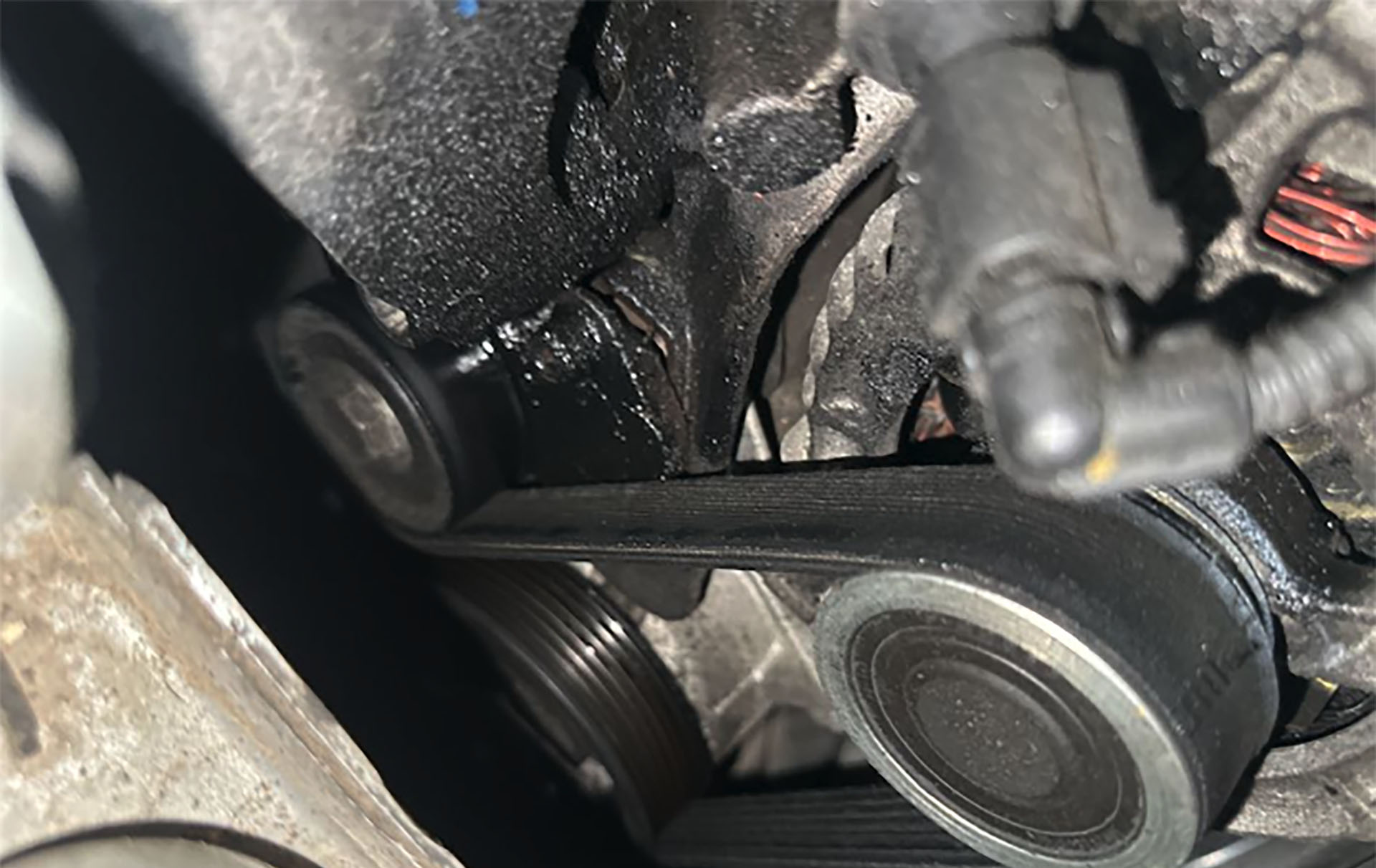
Oil on a Volkswagen Eos drive belt.
Oil on a Volkswagen Eos drive belt

Other than normal wear and tear, drive belts can go bad if there’s an oil leak. Oil leaks, if they aren’t addressed, may cause the belt to become weaker or break, resulting in damage to the engine.

Timing belts and timing chains

Not all vehicles have timing belts, they either have a timing belt while others have a timing chain.

Nowadays, more cars have timing chains than belts.

Timing chain.
Timing chain

These two parts have the same function, but there are some differences. Timing chains are oil lubricated. Timing belts aren’t, and it’s actually bad if oil gets on them.

Another difference is that timing chains have guide rails, while timing belts just have tensioners.

Whether your vehicle has a belt or a chain, make sure it’s inspected regularly and replaced when it has become worn.

HomeTowne Auto Repair & Tire is an authorized Michelin and BFGoodrich tire dealer located in Woodbridge, Virginia. Automotive repair services are performed on all makes and models, including oil changes, brakes, alignments, inspections, and computer engine diagnostics.

View Post

Different types of transmissions and how they work

In Uncategorized by HomeTowne Auto Repair & Tire

Transmissions transfer power to the wheels from the engine. They determine the force and speed based on where and how the vehicle is being driven.

There are a few different types of transmissions used today – manual transmissions, automatic transmissions, continuously variable transmissions (CVT) and automated manual transmissions (AMT).

Each kind differs in design, operation and components.

Types of transmissions

Manual transmissions

Manual transmissions consist of an input shaft, intermediate shaft and output shaft. 

The input and output shafts are each connected with the intermediate shaft.

There are also several gears that enable us to travel at various speeds, with lower gears used for slower speeds and top gears operating at faster speeds.

Because the gears aren’t attached to the output shaft, a hub and sleeve are needed to link them as you shift. In order to switch, the clutch must be disengaged.

It has a manual clutch where you press the pedal to disengage the transmission.

Automatic transmissions

Automatic transmissions use a planetary gearset, which is made up of an output and two inputs. As the input speeds change so does the output speed.

The output of another planetary set connects with an input of the first one.

This system also has two clutch packs, which prevent the ring gears from moving. While switching gears, the clutch pack is pressed. The ring gear stops while the carrier turns.

The output speed can rise if the ring gear is able to move. This is possible by letting go of the first clutch while simultaneously connecting with the second clutch. The ring gear then links to the carrier of the other planetary set.

An automatic transmission has a torque converter that connects the engine to the transmission, which allows a certain amount of slippage so you don’t need to push in a clutch pedal when you come to a stop.

There’s a valve body that is electronically and hydraulically controlled to change the shift points, depending on how the vehicle’s being driven.

Continuously Variable Transmissions (CVT)

A Continuously Variable Transmission (CVT) is an automatic transmission that offers various perks, such as less carbon dioxide emissions and fuel consumption.

This system consists of a couple of sheathes that are located on drive and driven shafts. Between them, sits a metal push belt. 

One of the sheathes is able to move on the shaft, allowing the transmission ratio to shift automatically and continuously.

CVT components team up with an electronic system. Together, they provide a good torque and RPM ratio.

Automated Manual Transmissions (AMT)

If your vehicle has an Automated Manual Transmission (AMT), you are able to shift manually or automatically. 

When you choose the automatic option, the gear adjusts on its own.

An AMT uses several parts – change lever unit, clutch actuator, gear shift unit and transmission control unit.

The change lever unit allows you to go from neutral to drive. When you shift gears, a signal is sent to the clutch actuator and gear shift unit by the transmission control unit. 

The system chooses the correct gear needed, which decreases damage to the clutch and improves fuel economy.

With this transmission, you get the best of both worlds of a manual and an automatic transmission.

Maintaining your transmission

No matter which of the types of transmissions your vehicle uses, it’s important to maintain it.

One way to take care of your transmission is through transmission fluid exchanges, which we recommend every 30,000 miles. The intervals also depend on the vehicle and what the manufacturer suggests.

Overtime, contaminants build up in the transmission fluid that acts as a lubricant. This can cause valves and solenoids to stick and parts to break down.

Transmission fluid exchanges help components last longer.

Some transmissions have a filter. You don’t have to necessarily change the filter during a fluid exchange, especially if they’re performed early on and through the life of the vehicle.

The filter acts like the air filter for your house. It filters out large contaminants that would normally go through the transmission. Depending on the car’s mileage and age it might be a good idea to also change the filter.

HomeTowne Auto Repair & Tire is an authorized Michelin and BFGoodrich tire dealer located in Woodbridge, Virginia. Automotive repair services are performed on all makes and models, including oil changes, brakes, alignments, inspections, and computer engine diagnostics.

View Post

Wheel alignments for Toyota vehicles

In Vehicle Alignment by HomeTowne Auto Repair & Tire

If you notice your Toyota vehicle is veering to the side, or you’re having difficulty steering, then it may be time to come in for a wheel alignment. In order to keep your car safely on the road, and your tires wearing down correctly, your tires need to be properly aligned.

Maybe your Camry hit a pothole or a curb, or perhaps your vehicle is experiencing suspension wear. Whatever the reason, an alignment ensures that your car doesn’t take unnecessary wear and tear.

Not sure if you need an alignment? You may be able to tell based on a few indicators – tires wearing unevenly, crooked steering wheels, and a vehicle pulling to one side are signs of bad wheel alignments.

How much are wheel alignments, and what do we do during them?

How much a wheel alignment costs depends on several factors, such as the kind of vehicle and the type of alignment needed.

The price can range anywhere from $80 to $188. If there are any parts or adjustments needed to bring the alignment into correct specification, that could be additional costs.

A lot of Toyota trucks, for example, can require more adjustments to the caster and camber than other trucks.

The age of a vehicle and where it’s from impact the alignment, as well.

Adjustments on a vehicle from a northern state, which have a lot of salt on the road during the winter, can seize up. Sometimes you have to work harder to free them up or may even need to replace the adjusters due to rust. 

During an alignment, our technicians check the caster, camber, toe, and thrust angles of your vehicle. Your Tundra can then be aligned for the manufacturer’s specifications on alignment, and your own preferences. Here’s an explanation of the different angles:

  • Camber: Camber describes how tires are angled in and out.
  • Caster: Caster is the forward or backward angle.
  • Toe: Toe refers to where the tires are in relation to the center.
  • Thrust angle: Thrust angle is used to compare the rear axle with the center and front axle.

After looking over and adjusting the angles, we may need to reset certain systems. This is sometimes needed for vehicles that use Advanced Driver-Assistance Systems (ADAS), such as park assist and blind spot detection.

When and why to get this service

Even if you’re not experiencing problems currently with your alignment, our technicians follow the industry standards and recommendations that you align your Toyota’s tires once a year, or every 15,000 miles. 

We also suggest this service when you buy new tires.

There are several benefits of getting a car alignment, like helping the tires last as long as possible.

Tire alignments aren’t a requirement, and if your tires are wearing evenly and you aren’t having problems with your Yaris then you can wait. However, by scheduling regular alignments according to the industry standard, you will ultimately save money on tires, as alignments ensure that the tires will wear down evenly over time.

Our technicians at HomeTowne Auto Repair & Tire can help schedule an appointment to evaluate your Toyota and provide an assessment on an alignment for your vehicle.

We can do wheel alignments for these Toyota and Scion vehicles:

  • Camry
  • Yaris
  • Sienna
  • Tundra
  • Tacoma
  • FJ Cruiser

HomeTowne Auto Repair & Tire is an authorized Michelin and BFGoodrich tire dealer located in Woodbridge, Virginia. Automotive repair services are performed on all makes and models, including oil changes, brakes, alignments, inspections, and computer engine diagnostics.

View Post

Why you should replace shocks and struts

In Shocks & Struts, Suspension by HomeTowne Auto Repair & Tire

While everyone wishes that their car could stay in perfect condition forever, oftentimes that doesn’t really happen. Parts and fluids in everyone’s car wear over time – at different rates – and require replacement and maintenance. 

Some parts of vehicle maintenance, like oil changes, need to be done more often. There are some replacements that need to be done over a longer period of time – like shocks and struts.

If you are noticing that your car is bouncing a lot, or nose diving, and you take it in to an auto technician, they may come back and tell you that you need your shocks or struts replaced. 

Many people don’t know what they are, and what they do in your car, so let’s look at that first.

Shocks and struts both absorb pressure from running over potholes, bumps and rough roads. Shocks are placed near the tires and have a coiled spring near them, as well as hydraulic fluid and a piston that help to absorb that shock. Struts are very similar, except that they’re built into the suspension system, and they have a coiled spring directly on the strut as one part.

There are different types of shocks and struts available.

So why should you be replacing these when they begin to wear out or go bad? Below are a few reasons:

Why replacing shocks and struts is important

It’s what the industry standard and manufacturer recommends

Our auto technicians follow the industry and manufacturer’s standards on all cars that come in. It is currently recommended that shocks or struts be replaced every 50,000 miles. Even though this can vary from car to car – and some vehicles can go longer than that – we still recommend and look for any issues with these components once you’re over that mileage.

Replacing them will give you more control while you drive

When your shocks or struts start to go, you’re going to see it when you’re accelerating, turning and braking. So once they start to degrade, you’re really going to see a decline in the control you have of your vehicle. Everyone has a different preference on the level of vehicle control they want when driving, but when you begin to have issues with braking or turning on a curve, then it’s time for new shocks and struts.

The life of your tires increases

Like we mentioned before, the job of the shocks or struts help to absorb shock you have from running over things like potholes. So when your shocks and struts begin to go, you’re going to see more bouncing, even when you’re not running over things. This bouncing will actually harm your tires. Because of the increased bouncing, your tires are hitting the ground hard and unevenly. This means that you’re going to possibly see pieces of tire worn off and even smooth patches from where the tires have worn down. This can actually minimize the life of your tires, which is an additional cost down the road if you don’t replace your shocks or struts.

Driving on the road is safer when you change the shocks and struts

When your shocks or struts are wearing down and you’re having problems with braking and bouncing, it becomes less safe for you to drive. By getting them replaced, you’re investing in the safety of your life, your passenger’s lives and everyone else out there on the road.

If your technician at HomeTowne Auto Repair & Tire suggests that you get your shocks or struts replaced, take them seriously. It will help improve your driving experience, extend the life of your car, and keep you safe.

HomeTowne Auto Repair & Tire is an authorized Michelin and BFGoodrich tire dealer located in Woodbridge, Virginia. Automotive repair services are performed on all makes and models, including oil changes, brakes, alignments, inspections, and computer engine diagnostics.