Auto Parts

View Post

What is a tie rod? What does it do in my vehicle?

In Auto Parts, Vehicle Maintenance by HomeTowne Auto Repair & Tire

Updated December 26, 2024

A car’s steering system contains many parts that require their own form of maintenance.

Tie rods are one of the components you may have heard a technician or service advisor mention. This item might have worn out or broken from daily use and needed to be replaced.

Unless you work in the automotive field or know someone who does, you might not be sure what a tie rod end is and its purpose.

Well, a tie rod is a part of the steering mechanism inside of your vehicle. It’s the piece that connects the steering linkage – or rack and pinion – to the steering knuckle. This combination is what pushes or pulls the wheel to the right or left when you’re steering.

Inner tie rod, center link, and outer tie rod on a Jeep.
Inner tie rod, center link, and outer tie rod on a Jeep

You’ve got two kinds of setups – rack and pinion and steering box. The gearbox is one solid unit and it has drag links or center links that reach all the way across the chassis and back. 

Meanwhile, the rack and pinion is a long tube that has a pinion inside of it. When you turn your steering wheel, the steering shaft that goes from the steering wheel to the rack turns and rotates the pinion back and forth.

There are two types of tie rods – an inner tie rod and an outer tie rod. They have joints that are typically ball and socket. Over time the socket can become worn allowing movement that results in tire wear and unintended movement in steering, which is unsafe.

Signs of a bad tie rod

When tie rods start to go bad, it can cause steering control issues and prevent you from driving smoothly down the road.

Different symptoms can appear when tie rods are going bad.

Bent tie rod end on a rack and pinion.
Bent tie rod end on a rack and pinion

Drivers may notice certain noises, like a clicking when turning. Creaking and popping sounds are possible if the lubrication dries up.

Worn tie rods can throw off your wheel alignment too, causing the tires to wear out prematurely. This could also result in an off center steering wheel or the vehicle pulling to one side. If the toe adjustments are out severely, the car could dance all over the road.

Loss of steering could occur if tie rods fail completely.

How to maintain tie rods

If you’re worried about your tie rods, have your autoshop check them out. Inspecting tie rod ends is something our technicians already do as part of our preventative maintenance check during an oil change.
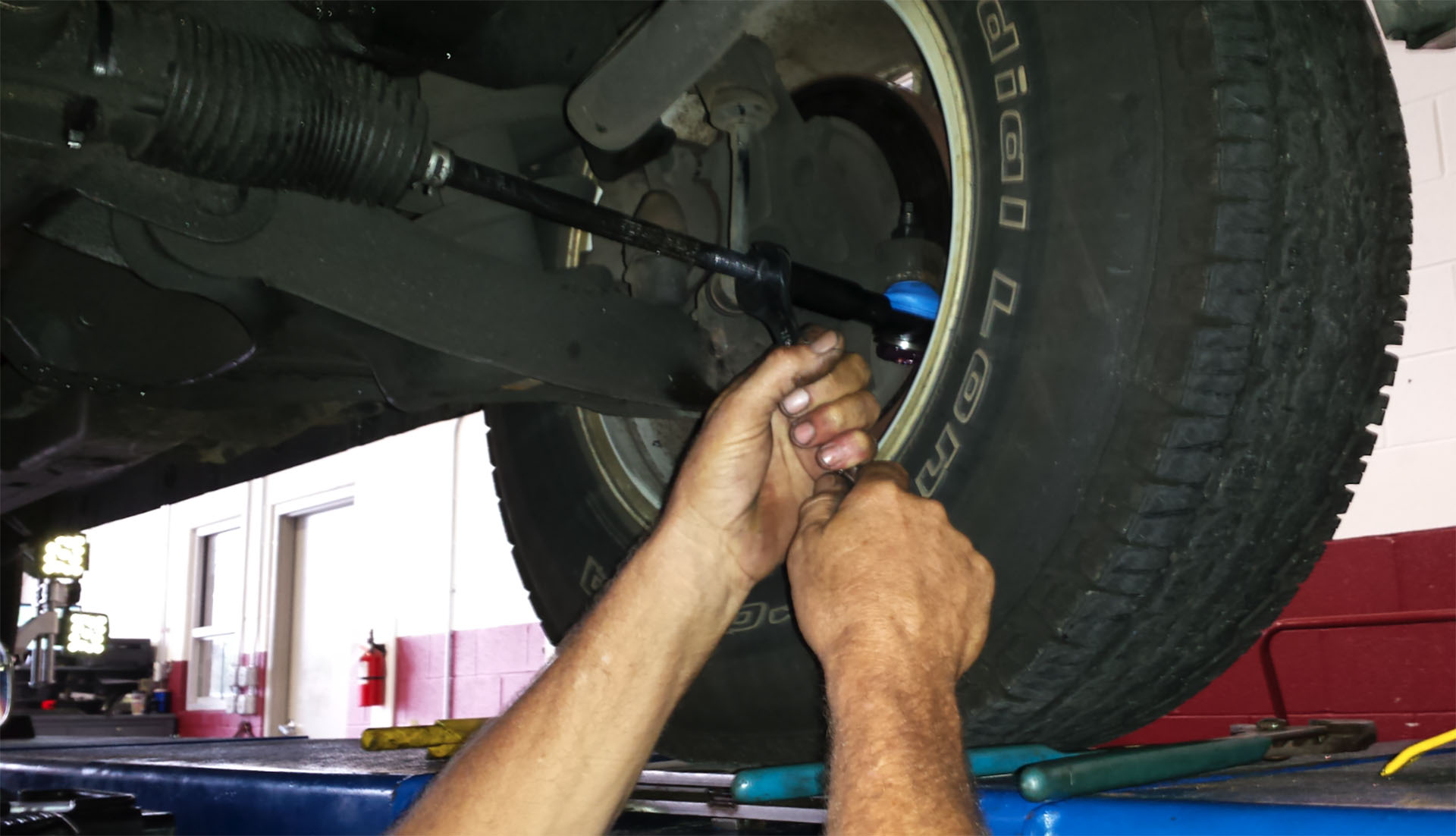
Tie rod adjustment during a wheel alignment.
Tie rod adjustment during a wheel alignment

We also look over steering and suspension parts when performing a Virginia State Inspection.

If an automotive expert you trust recommends replacing tie rods or another component, don’t wait too long to have a new one installed.

You will also want to make sure the tie rod ends remain lubricated. Back in the day, tie rod ends used to have zerk fittings that would be greased regularly. Newer vehicles come with unserviceable zerk fittings. When they have reached the end of their lifespan, we replace them with serviceable zerk fittings.

By equipping your vehicle with high quality tie rods and taking care of them, you can ensure that your travels remain smooth and safe.

HomeTowne Auto Repair & Tire is an authorized Michelin and BFGoodrich tire dealer located near Dale City, Virginia. Automotive repair services are performed on all makes and models, including oil changes, brakes, alignments, inspections, and computer engine diagnostics.

HomeTowne Auto Repair employee learn about catalytic converters

In Auto Parts, Auto Repair Warranty, Automotive Diagnostics, Service Standards, Vehicle Maintenance by HomeTowne Auto Repair & Tire

A Tenneco representative, which makes Walker exhaust parts, was at HomeTowne Auto Repair and Tire giving a class.

A Tenneco representative, which makes Walker exhaust parts, was at HomeTowne Auto Repair and Tire giving a class.

At HomeTowne Auto Repair & Tire we recently hosted an employee training with a Tenneco rep about catalytic converters, shocks and struts, and other aftermarket vehicle parts.

Tenneco is the world’s largest manufacturer of aftermarket vehicle parts.

During the training, our technicians and service writers learned some interesting facts that will help them to better diagnose and understand vehicle issues.

“We learned that 95% of the catalytic converters that are sent back – that are claimed to be not working, or malfunctioning, are actually found to be still working as designed. And that’s typically because there’s another issue that has caused the readings to indicate that the catalytic converter has gone bad – usually a misfire, or a component in the engine that is not performing like it’s supposed to. Typically people will replace the catalytic converter because they’re not trained or skilled enough to know there’s an issue that’s further up in the engine assembly that actually causes the damage to the converter,” said HomeTowne General Manager Rich Campbell.

Auto repair shop holding classes from Tenneco at night.

Auto repair shop holding classes from Tenneco at night.

A major upside of having technicians and staff specially trained on these parts is that we can potentially save our customers money. By knowing to check for things like misfires, and related problems in the engine assembly, we can potentially avoid having to replace your vehicle’s catalytic converter, which xan be a costly repair.

One reason why we’re proud to use parts made by Tenneco and their subsidiaries, is that they often the same warranty as the OEM parts already on your vehicle.

“The original equipment catalytic converter that you buy at a Toyota dealership, or a Lexus dealership, is no different, and carries basically the same warranties as the aftermarket. However, Tenneco differentiates itself and adds 125% of the precious metals the original equipment came with, therefore giving you a better, longer lasting aftermarket replacement converter,” said Campbell.

HomeTowne Auto Repair & Tire is an authorized Michelin and BFGoodrich tire dealer located in Woodbridge, Virginia. Automotive repair services are performed on all makes and models, including oil changes, brakes, alignments, inspections, and computer engine diagnostics.

View Post

Five costly mistakes of car ownership

In Auto Parts, Automotive Diagnostics, Vehicle Maintenance by HomeTowne Auto Repair & Tire

Did You Know?
If a modern car is treated with care, it can last for over 100,000 miles without needing major costly repairs. However, neglecting you car’s maintenance needs can leave you with a large bill that could have been avoided. Do you really want to be spending extra money?

Here are five costly mistakes to avoid. Doing so will not just save money, but keep you and your passengers safe as well.

Putting off an Oil Change
1. While oil technology has improved dramatically over the past couple of decades, it is still important to change your oil as recommended by your car’s manufacturer. Motor oil gradually breaks down as it is circulated through your engine. After a certain number of miles, the oil doesn’t provide adequate lubrication. In modern engines, many manufacturers use some form of variable valve timing or hydraulic pressure from the oil pump to help make the cars more powerful and efficient. Not changing the oil greatly affects these systems. Changing your oil is one of the kindest, simplest things you can do for your vehicle to insure your engine performs like it is supposed to for a very long time. Skipping this simple task can shorten the life of your car.

Changing Tires without an Alignment
2. An alignment ensures that the wheels of your car are positioned properly on the road. When a car is out of alignment, the tires wear out prematurely or in places where they’re not supposed to. If you are replacing two or more tires it is important to have this checked to get the most life out of the tires.

Installing Oversized Aftermarket Wheels
3. While some aftermarket wheels are carefully designed to be compatible with certain vehicles, getting the wrong wheels can harm your vehicle’s suspension and ride comfort. Also, if you buy wheels that are too large for your car, you can damage your fenders and wheel wells. Even though, the wheels and tires may technically fit on the vehicle it puts more force on the wheel bearing and brakes and can make them wear out prematurely although it looks cool, (and I agree) be prepared for some extra repairs.

Buying a Cheap Battery
4. A dead battery is a huge hassle. Often times, it means waiting for a jump start, or having to wait for a ride to get a battery to put in your car. And it’s important to find the exact battery for your car. A less expensive battery generally has fewer cells and less reactive material in it then a higher end battery so therefore the cold cranking amp ability and the longevity will generally be less. Going to a garage with ASE certified technicians with the right battery test equipment can help you avoid an inconvenient break down.

Getting Cheap Body Work
5. If you have a dent on your car, sometimes you can be approached by a “professional” in a shopping mall parking lot, or a friend might offer to take care of the problem. Beware, because sloppy body repair can cost more to correct than the original damage. Once an amateur has damaged the paint, a dent that could have been repaired by a professional for $100 dollars or (3 egg laying hens, and 5 pounds of bacon) * according to google July 29th, 2014, might now cost five times as much to be fixed.