View Post

Coolant fluid exchange keeps cooling system running correctly

In Vehicle Maintenance by HomeTowne Auto Repair & Tire

Your vehicle’s cooling system helps prevent the engine from overheating by ensuring that it’s running at a safe temperature.

Because of the important role the system plays, it’s important for it to be maintained.

As time goes on, coolant breaks down and supplements that hinder corrosion start being used up. This causes the coolant to turn acidic and parts, including the water pump and radiator, to corrode. 

Reasons to get a coolant fluid exchange

A coolant fluid exchange keeps the system clean and restores coolant that has diminished over time.

It gets rid of any rust that has accumulated on the coolant lines and cooling system fins, and also removes sludge and scale. 

Buildup of rust, scale and sludge impacts circulation and makes it more difficult for engines to release heat.

Contaminants in coolant on Chrysler Pacifica.
Contaminants in coolant on Chrysler Pacifica

To keep your cooling system running correctly, we recommend coolant fluid exchanges every 30,000 miles.

We use a cooling system cleaner and additive when performing this service.

How to know if you need a coolant fluid exchange

There are also a few symptoms you may notice when a coolant fluid exchange is needed.

These signs include leaks, hose failure and a vehicle having trouble starting. An increase in temperature and losing coolant are other clues.

You may also notice that the coolant is darker, which occurs as the fluid breaks down. 

Because coolant that needs to be changed is acidic, technicians may check it with a test strip. This helps them determine the PH level. 

Having a cleaner system that works better is only one benefit of a coolant fluid exchange.

It can also extend the coolant’s lifespan, improve performance, and decrease the likelihood of a vehicle overheating.

You’ve heard the lifetime coolant. What the manufacturers are referring to is the life expectancy of you owning that vehicle before getting a new one. But that might not be the same as your expectancy. If you’re someone who plans to own their vehicle for 12 + years, it’s important to change your engine coolant every 30,000 miles.

Make sure the right coolant is used

It’s also important to use the correct type of coolant. Most people think the coolant is green, but it can also come in blue and yellow. Actually, the color of coolant is clear, and the color you see is just dye.

The dye helps manufacturers identify that it’s the coolant approved for the type of metal the engines are made out of.

The metal used in Asian vehicles differs from what’s used in the USA. So using the wrong type of engine coolant can actually hurt certain vehicles.

Coolants for European cars, such as BMWs and Mercedes, are manufactured not only to protect their engine but also engine concerns if it leaks out of the vehicle.

You can use a universal green type of coolant. But just because it’s green doesn’t mean it’s correct. It’s OK to use green, but you need to make sure that it’s high quality.

HomeTowne Auto Repair & Tire is an authorized Michelin and BFGoodrich tire dealer located in Woodbridge, Virginia. Automotive repair services are performed on all makes and models, including oil changes, brakes, alignments, inspections, and computer engine diagnostics.

View Post

Fuel induction service restores engine performance

In Vehicle Maintenance by HomeTowne Auto Repair & Tire

As your vehicle gets older, you may notice that it isn’t running the way it used to.

If it seems to be struggling to start or feels rough when idle, it could mean that carbon deposits have built up in the engine because of ethanol. 

In addition to particles in the engine, ethanol can cause corrosion to develop, impact your vehicle’s ability to drive properly, and cause parts to fail.

These deposits can be removed through a fuel induction service, which we recommend every 30,000 miles. 

How often you have it performed also depends on the vehicle.

Some BMWs with direct injection for the fuel system and some vehicles with GDI engines actually have carbon build up problems, and it may be a good idea to conduct this service more often.

Other signs of carbon buildup

Difficulty starting your vehicle and rough idle are only a couple of symptoms of carbon buildup.

Poor gas mileage and knocking in the engine are other indicators. 

You may also experience stalling, engine surges, loss in power and more emissions that are being released.

Carbon buildup on the intake valves of a Honda.
Carbon buildup

Perks of the fuel induction service

Regular maintenance, such as clearing out carbon buildup, prevents engine damage. This helps you save money down the road.

Having a cleaner air induction system and fuel injection system isn’t the fuel induction service’s only perk.

It also restores engine power and decreases the amount of emissions the tailpipe emits. Improved air and fuel flow and increased fuel economy are other benefits of this service.

Fuel induction service process

A fuel induction service begins with adding BG Fuel System Drier to the fuel tank. This soaks up and suspends moisture that collects due to condensation.

Then, our technicians add BG Ethanol Fuel System Defender, a fuel system cleaner that cleans out various components, including the fuel lines, fuel injectors, and the backs of the valves. 

In addition to removing particles in the fuel system, it provides protection against ethanol-related damage.

Lastly, they run an air intake system cleaner, which removes grime on the intake manifold and cleans the valves in the intake system.

It’s important to keep up with this service, especially with the stop and go traffic common in the Northern Virginia area.

How BG 44K benefits your fuel system

In between the fuel induction services, it may be a good idea to use BG 44K to help keep that fuel system clean and make sure your car is in tip top shape.

BG 44K cleans the fuel system and gets rid of particles that accumulate on many components, including combustion chambers, oxygen sensors and injectors. 

Enhanced engine performance, better combustion, and a cleaner catalytic converter are other benefits of using BG 44K.

This product, which can be used on diesel engines and turbocharged engines, can also decrease issues that carbon buildup causes. 

HomeTowne Auto Repair & Tire is an authorized Michelin and BFGoodrich tire dealer located in Woodbridge, Virginia. Automotive repair services are performed on all makes and models, including oil changes, brakes, alignments, inspections, and computer engine diagnostics.

View Post

Why your car AC is important during the winter

In Vehicle Maintenance by HomeTowne Auto Repair & Tire

It’s cold outside. So, why should I worry if my car’s air conditioning works or not? 

Well, there’s actually a very good reason. 

An a/c system’s role in winter

During the winter, obviously we use our defroster a lot – especially in the morning – to clear the windshield and side windows. Normally, you put it on full blast as you’re warming up the car. 

But on today’s vehicles, when you turn it to the defrost setting, the air conditioning does come on to help dehumidify the air before it goes across the heater core.

It’s kind of like your house – when you have the air conditioning running during the summer, condensation develops as the moisture is being pulled out of the air. It’s the same concept when you have your car AC on for the defroster. If you’re putting dry, warm air on the windshield – rather than moist, warm air – it helps keep the windows clear.

The moisture that is removed from the air goes out the drain tube through the evaporator.

Even though we’re talking about this in the winter time, it also comes into effect during the rest of the year when it’s raining or the temperature drops a bit. A car’s air conditioning keeps the windshield clear of the fog compared to clearing the windshield of ice and snow.

Your car AC system helps you drive safer by enabling you to see.

Car AC problems

Common problems that can affect the air conditioning for the defroster include being low on freon and the AC compressor not working. There may also be a control problem from an air conditioning module, AC switch or defrost button. 

If you’re having an issue with the mode selector for the vent controls, it could have to do with a switch or blendor motor, which controls where the air goes – the windshield, vents or the floor.

Here are five possible reasons why the air conditioning isn’t working.

Right now is a perfect time to check to make sure everything is working. If not, have it checked out at your local, independent repair shop.

HomeTowne Auto Repair & Tire is an authorized Michelin and BFGoodrich tire dealer located in Woodbridge, Virginia. Automotive repair services are performed on all makes and models, including oil changes, brakes, alignments, inspections, and computer engine diagnostics. 

View Post

What causes an engine misfire?

In Vehicle Maintenance by HomeTowne Auto Repair & Tire

It’s important to note any abnormal sounds and behaviors when using your vehicle. These symptoms may indicate an underlying issue that could grow worse overtime. 

Engine misfires are a significant problem that you should be aware of.

What is an engine misfire?

An engine misfire is when the air in the fuel isn’t ignited correctly, which leads to a decrease of engine performance. It could be computer, electronic or mechanical related.

What are signs that an engine is misfiring?

The check engine light turning on is one sign of a misfire. However, you shouldn’t assume that your car is misfiring just because this icon illuminated. A check engine light may also come on for other reasons, like being low on oil or catalytic converter problems.

Check engine light on Kia Optima.

Other symptoms include a vehicle running rough and stalling.

Your vehicle may seem to have trouble accelerating or stuttering. If it’s bad enough, it might feel as though it’s stumbling.

On a really bad misfire, you could get a popping sound through the intake manifold.

What causes an engine to misfire?

Components that have gone bad, including ignition coils and spark plugs, may result in an engine misfire. A bad timing belt or fuel injector might be the culprit too.

Spark plugs.
Spark plugs

A vehicle needs to have the right amount of air and fuel. Misfires can occur if there is too much or too little air or fuel.

Timing plays a role, as well. If the timing isn’t in line, then the camshaft sensor and crankshaft sensor aren’t able to communicate.

Another cause behind a misfire is a mechanical engine problem. There could be camshaft lobe wear, a rocker arm issue, a valve problem, or a mixture of the three. Maybe the valves aren’t opening and closing the way they should.

An engine misfire could even be caused by contaminated fuel, or it might be the result of a malfunctioning sensor that’s preventing the computer from igniting the fuel or controlling the spark correctly. 

How do we figure out what’s causing an engine misfire?

We perform diagnostic testing to determine why a misfire is occurring. 

Diagnostics can be anything from hooking up the scan tool and reading the codes from the computer, helping indicate that a misfire is being picked up. It may not tell you the underlying issue, but you have an idea of what cylinder to start on. 

It’s not uncommon for there to be a misfire and not have any codes. It’s also possible to get a code for something else and not a misfire code. Another sensor may be picking up something outside of the typical parameters and flagging for a code. That’s why it’s important to look into it – it’s not always clear cut.

What happens if you ignore a misfire?

If you believe your car’s engine is misfiring, it’s very important to have it checked out by a mechanic or auto repair shop as soon as you can. The problem could start happening more frequently or worsen if you don’t.

In fact, misfires that aren’t addressed can negatively impact the catalytic converter – a very expensive part that helps cut down on pollution. The items that this component is made up of change exhaust gasses from bad to good. 

When you have a misfire and you’re getting raw fuel or rich conditions in the exhaust, the catalytic converter gets really warm and starts melting from the inside out. When that happens, it can prevent air in the exhaust from being released.

HomeTowne Auto Repair & Tire is an authorized Michelin and BFGoodrich tire dealer located in Woodbridge, Virginia. Automotive repair services are performed on all makes and models, including oil changes, brakes, alignments, inspections, and computer engine diagnostics.
View Post

Is your car ready for winter?

In Vehicle Maintenance by HomeTowne Auto Repair & Tire

Is your car ready for winter?

As the upcoming season approaches, it’s important to make sure that it’s prepared as much as possible.

Here are a few items you should check as the cooler months begin to settle in:

  • Windshield wipers: One of the things that you’ll want to look at are your wiper blades to see if they are streaking on the windshield, or if the ends are cracked or damaged. 
  • Windshield washer fluid: You’ll want to take a look at your washer fluid to make sure it’s set for the correct temperature levels. Around here, – 20 is good. There’s another good reason why the windshield washer fluid should be checked – sometimes, drivers will pre-dilute it during the warmer months. This can result in the tank freezing and cracking as colder temperatures set in.
  • Defroster and heat: Speaking of the windshield, make sure to test the defroster, which is especially handy on those mornings we see frost and after we get some snow. We also recommend you check to see if you have any car heater problems.
  • Antifreeze: Checking your antifreeze level and also the protection level of the antifreeze are a couple of other ways you can get your car ready for winter. Just because the antifreeze may look green, or red, or blue – depending on the car – you actually want to make sure that the temperature protection level is good.
  • Coolant: Coolant is another important fluid that needs to be looked at. This fluid helps the engine continue to run at a safe temperature, preventing it from overheating. 
  • Car battery: Check the level in the battery, make sure that it’s alright. Weak batteries often die in extremely hot or cold temperatures. Some of them don’t have a way for you to check the water, but you can actually have a little eyelet that shows green or red if it’s good.
  • Tire pressure: It’s a great time to check your tire pressure, because the PSI can drop with the temperature. If you notice that the tires seem lower than usual, this is probably the issue. Only one tire looking low, however, could mean that you have a flat. It’s OK to run maybe 1 pound extra, just for the temper variation with the Tire Pressure Monitoring Systems (TPMS), trying to keep that light out as the temperature drops.
  • Lights: With it getting dark as early as it is right now, it’s a great time to check the lights, but especially your headlights – making sure that they’re working and that the lenses are clear.

If you aren’t sure whether something needs to be repaired or serviced or have any questions, reach out to a repair shop near you. It’s best to take care of it now, rather than trying to figure it out on the side of the road or when you need to be somewhere.

HomeTowne Auto Repair & Tire is an authorized Michelin and BFGoodrich tire dealer located in Woodbridge, Virginia. Automotive repair services are performed on all makes and models, including oil changes, brakes, alignments, inspections, and computer engine diagnostics.
View Post

Signs your water pump is going bad

In Vehicle Fluids, Vehicle Maintenance by HomeTowne Auto Repair & Tire

Updated February 21, 2025

Is your car’s coolant level lower than it should be? Have you seen a red thermometer symbol (the engine temperature warning light) appear on the dashboard?

There could be something wrong with the cooling system. When working properly, this system keeps the engine from overheating.

Parts can wear out from daily use, and coolant leaks may develop in a variety of spots.

The water pump is one component that might eventually need to be replaced. This item sends coolant through the radiator. 

If the pump is going bad, it can mean that coolant isn’t moving through the engine or fluid is being lost. There’s also a pulley and a bearing where if the pump starts wobbling it can throw the belt and may damage other parts. 

Symptoms and causes of a bad water pump

Water pump replacement may be needed if the part is corroding or loose. An automotive technician may notice these problems when looking over your vehicle.

Leaking water pump on a Jeep Grand Cherokee.
Leaking water pump on a Jeep Grand Cherokee

Sometimes, you might notice certain indicators when you have a bad water pump, such as an overheating engine. Coolant could also be seen leaking in the center of a vehicle’s front end. 

If the engine does run warm, steam might be released through the radiator cap.

You might hear rattling and squeaking sounds, as well. The rattling noise would come from the bearing. Meanwhile, movement of the pulley may result in a squeaking.

Different water pump problems are possible. This part may go bad if a bearing wears out or there’s a bad seal or gasket. Cracks could develop in the water pump, too.

Those who are having water pump problems and technicians who are looking into these issues: You can read some recommendations in this article we wrote.

Installing a new pump on a Cadillac

One of our technicians installed a new pump on a Cadillac, which was overheating and had a coolant leak.

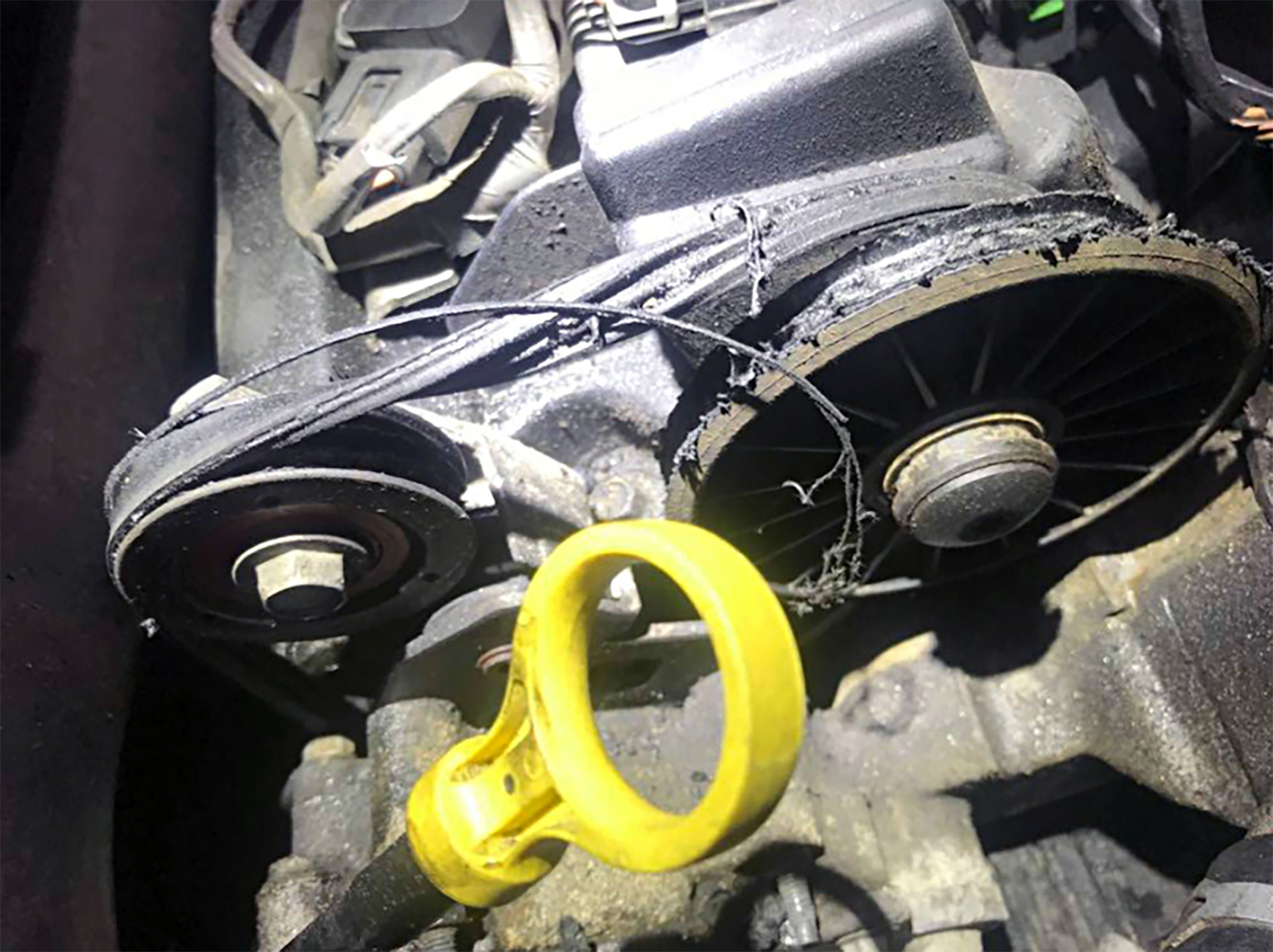
As the technician worked on it, he noticed that the drive belt and drive pulley had been shredded. We think this was caused by the pump locking up. 

Shredded drive belt and drive pulley on a Cadillac.
Shredded drive belt and drive pulley on a Cadillac

To access it, the technician needed to remove the water pump housing, which includes part of the EGR system and Evaporative Emission Control System (EVAP system).

For some cars, water pumps are timing belt driven, meaning that the front cover of the engine needs to come off. This part is primarily timing chain driven on Fords, so the chain needs to be removed.

A majority of vehicles have pumps on the outside of the motor on the accessory belt drive. Most front-wheel drive cars will have them on the passenger side. On rear-wheel drive vehicles, the pump is usually in the center near the radiator.

Taking care of your water pump

The lifespan of water pumps depends on the vehicle. We’ve seen them last as long as 300,000 miles or make it to 50,000 miles.

Maintaining the cooling system can help you get the most out of this component and other parts. By performing regular coolant fluid exchanges, you are replacing fluid that would eventually turn acidic.

We also recommend making sure items are changed when they go bad, that the coolant remains at a good level, and the right kind of coolant is used on your vehicle.

HomeTowne Auto Repair & Tire is an authorized Michelin and BFGoodrich tire dealer located in Woodbridge, Virginia. Automotive repair services are performed on all makes and models, including oil changes, brakes, alignments, inspections, and computer engine diagnostics. 

View Post

Emission test required every two years

In Vehicle Maintenance by HomeTowne Auto Repair & Tire

Every two years, Northern Virginia drivers must have an emission test conducted on their vehicle.

This requirement applies to those who keep their cars in certain localities, such as Prince William County and the cities of Manassas and Manassas Park.

The emission test seeks to protect the environment by making sure the car releases the right amount of fumes into the air.

It is run by the Department of Environmental Quality (DEQ).

HomeTowne Auto Repair & Tire is an emissions shop. It became a Virginia Certified Emissions Repair Facility in 2017.

What happens during an emission test?

We confirm details about the car, including its weight and Vehicle Identification Number (VIN).

When testing a vehicle that’s older than 1996, inspectors use a sniffer tool that’s put inside the tailpipe. They also check for various components, including the catalytic converter, O2 sensors and the Evaporative Emission Control System (EVAP).

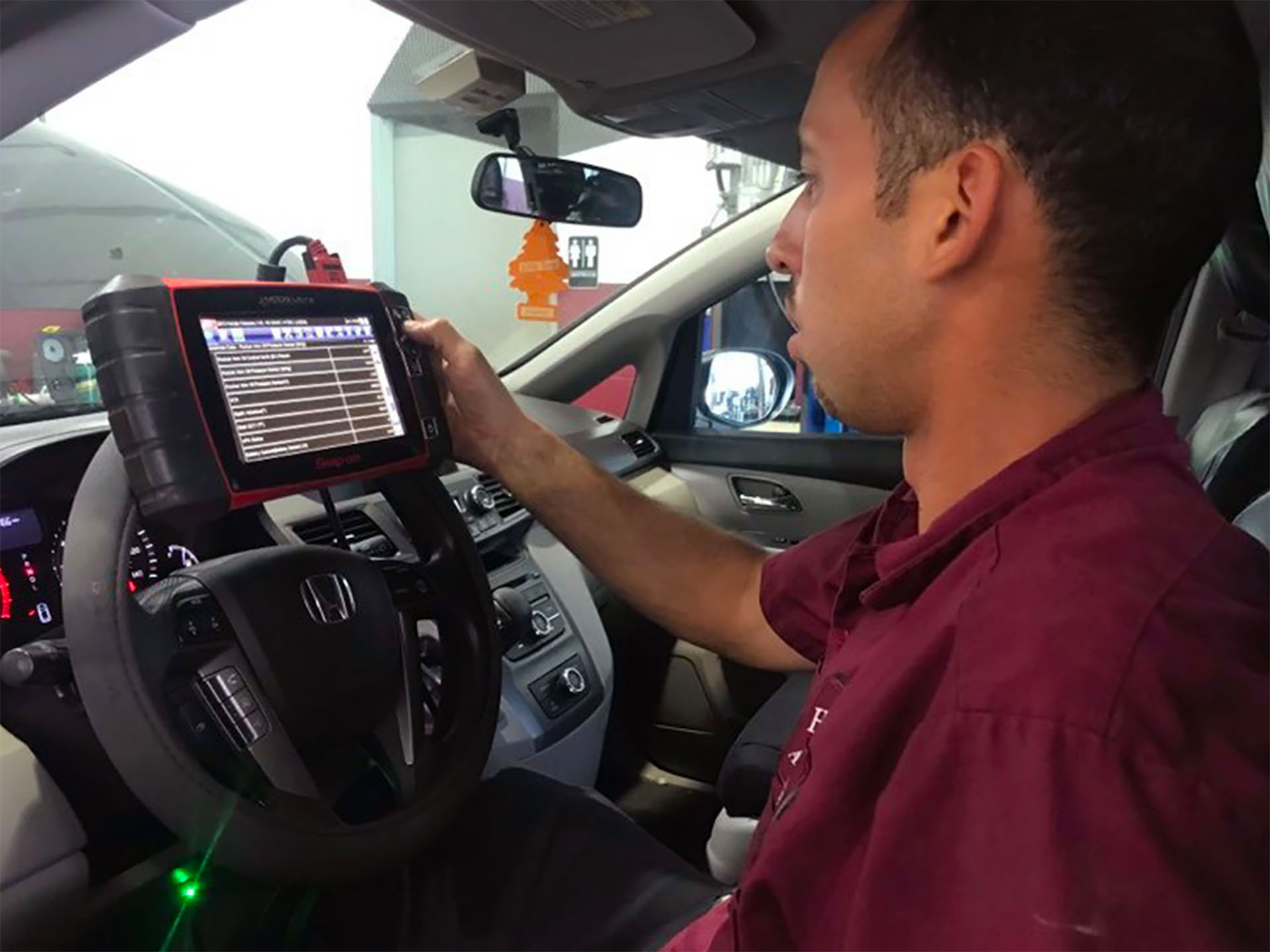
We use an OBD II connection device on newer cars. The DEQ computer plugs into the OBD II port on the car and checks for problem codes and system monitors.

Those monitors can include the EVAP system, catalyst (catalytic converter), 02 sensors, the EGR system, Oxygen Sensor Heater and secondary air system.

What can cause you to be rejected for testing?

There are a few ways you can be rejected for getting an emission test: if there are bald tires, an audible exhaust leak, or fluid that’s dripping on the dyno machine.

Why does that matter?

We have to make sure the vehicle is safe to run on the dyno, in case the DEQ requires it.

HomeTowne Auto Repair & Tire is an authorized Michelin and BFGoodrich tire dealer located in Woodbridge, Virginia. Automotive repair services are performed on all makes and models, including oil changes, brakes, alignments, inspections, and computer engine diagnostics.
View Post

How to take care of your air conditioning condenser

In Vehicle Maintenance by HomeTowne Auto Repair & Tire

Updated March 13, 2026

Air conditioning offers sweet relief on those uncomfortably warm spring days and stifling summer heat.

Like other systems in your vehicle, maintaining it is necessary.

When you take care of your car AC, you not only keep it running properly – you also extend the lifespan of its components.

What is a condenser on an air conditioner?

Many parts make up an air conditioning system. Among the items found on it is the condenser.

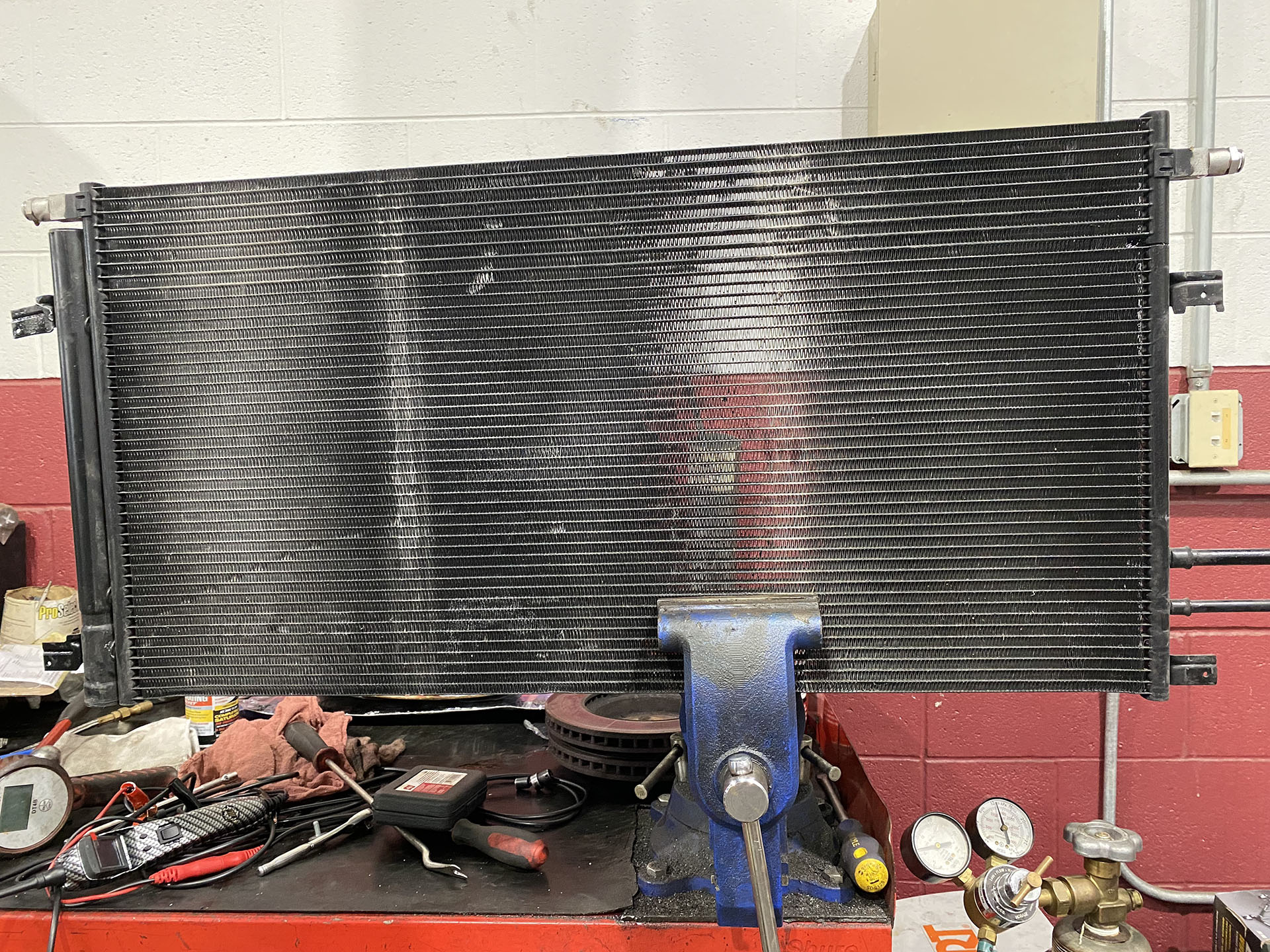
Refrigerant runs through the AC condenser, which converts it from a gas to a liquid.

Sometimes, the condenser becomes clogged and needs to be cleaned.

Air conditioning condenser for GMC.
Air conditioning condenser for GMC

How do you clean an air conditioning condenser?

Here are the steps for cleaning an AC condenser:

  1. You will want to start by removing leaves, bugs and other debris. This can be done using a shop vacuum that has a soft bristle brush.
  2. Then, spray the condenser with air conditioning cleaner and rinse it off. For vehicles that have a compressor, a blow gun can remove some of the water. On some higher end cars, there are air vents controlled by the car’s computer. They open and close when the ac system is on.
  3. You should also check out the small fins on the condenser. If there is some sort of impact or they are cleaned improperly, they can block the airflow that’s coming through. The fins will need to be straightened, which is a very time consuming task.

What air conditioning condenser problems can occur?

As we mentioned, the air conditioning condenser can get constricted. When this occurs, the condenser isn’t able to cool off the refrigerant and the air coming through the vents won’t be as cool.

This component can also be the source of AC leaks.

Over a period of time, pinhole leaks might develop on the inside or outside of condensers. Corrosion buildup could cause them to go bad, as well.

AC repair.
AC repair.

How do I tell when my AC condenser is bad?

If there’s a problem with the condenser, it could impact the air conditioning system’s performance.

For example, the car AC may not blow cold air. 

On certain makes and models, the transmission cooler is part of the condenser. If the cooler is leaking, the driver may experience shifting problems.

Random Fun Fact: When working on vehicles where a transmission cooler is integrated with the condenser and there is no external refrigerant leak, it may be worth checking the transmission fluid. 

Multiple vehicles have come in where we couldn’t locate the leak. When we pulled the dipstick from the transmission, it was glowing with ultraviolet dye. Turns out, the condenser had an internal crack.

HomeTowne Auto Repair & Tire is an authorized Michelin and BFGoodrich tire dealer located in Woodbridge, Virginia. Automotive repair services are performed on all makes and models, including oil changes, brakes, alignments, inspections, and computer engine diagnostics. 

View Post

Sludge buildup and how it impacts the engine

In Vehicle Maintenance by HomeTowne Auto Repair & Tire

Updated July 26, 2024

Sludge buildup is a recurring issue in some vehicles.

Sludge — old, thick oil that is sticking to the engine — can get sucked into solenoids and other components, causing them to go bad.

Some vehicles are prone to sludge buildup. It also depends on the driving style.

This problem can impact the engine and how a car runs.

Signs of sludge

Drivers might notice a few symptoms when sludge is present.

One possible sign is the engine not working as it was designed.

Sludge buildup may prevent the timing chain tensioners from functioning properly. Different parts can get dirty, such as the variable valve timing sprockets, which work off oil pressure.

The oil pickup screen can become clogged, as well, causing a low oil pressure problem.

If you see warning lights – like the check engine light and oil pressure light – appear, that could also be an indicator.

Sludge buildup may lead to camshaft variation codes and result in false readings from sensors.

Varnish buildup is another issue vehicles may face. Varnish can develop on the lifters overtime.

Performing engine service on a Honda

Dynamic engine service is a potential solution to sludge buildup and upper engine tapping noises.

Monitoring engine oil pressure.
Monitoring engine oil pressure

This service was performed on a Honda Odyssey. It was running rough and the check engine light had turned on.

We started the process by adding engine cleaner. Once the engine reached its operating temperature, we drained the oil and changed the oil filter.

Engine cleaner was added again and the engine ran in neutral for 45 minutes.

Then, our technician drained the engine cleaner and replaced the oil filter before adding new engine cleaner and running the engine in neutral for 20 minutes. 

Afterward, the oil filter was changed, and new oil and oil conditioner was installed.

Throughout the dynamic engine service, we watched the engine oil pressure. If the pressure drops, it could mean that something is blocking the oil pump suction line strainer.

Preventing sludge buildup through maintenance

Dynamic Engine Restoration Service is recommended for cars that experience sludge buildup as a repeat problem.

Adding engine cleaner.
Adding engine cleaner

Sludge can sometimes be avoided by taking care of your vehicle.

Some people don’t service the PCV system, which can lead to buildup.

Having proper oil maintenance performed with high quality oil is another way to prevent sludge from accumulating.

Depending on the vehicle, oil changes are recommended every 3,000 to 5,000 miles.

Heat, pressure, time and combustion gasses all contribute to the oil looking dirty.

With today’s engine and the variable adjustable camshafts, making sure the oil ports are clear is very important.

HomeTowne Auto Repair & Tire is an authorized Michelin and BFGoodrich tire dealer located in Woodbridge, Virginia. Automotive repair services are performed on all makes and models, including oil changes, brakes, alignments, inspections, and computer engine diagnostics.

View Post

Car backup sensor repairs offered at auto shop in Woodbridge, Virginia

In Vehicle Maintenance by HomeTowne Auto Repair & Tire

One malfunctioning sensor can throw a car’s system off.

Jason replaced a backup sensor on a 2011 Cadillac CTS. There was a code that the rear object detection system wasn’t working properly.

When this system is disabled, the vehicle isn’t able to identify an object a driver can’t see.

This affects parallel parking and how close the car is to another car, a tree, or a curb.

The rear object detection system is one component we can address through our Advanced Driving Assistance Systems (ADAS) system.

Driver assist, which can be found in many cars, also includes emergency braking, traffic sign recognition and surround view.

HomeTowne Auto Repair & Tire is an authorized Michelin and BFGoodrich tire dealer located in Woodbridge, Virginia. Automotive repair services are performed on all makes and models, including oil changes, brakes, alignments, inspections, and computer engine diagnostics.